
Resilience is Built, Not Delivered: Energy, Storage, and Local Capacity in Mining Systems
RW Rockshell Services
Following our work on knowledge preservation and open engineering systems, the next step is practical: how do we design mining and infrastructure systems that continue to function under stress—whether that stress is economic, environmental, or logistical?
Across disaster response research, infrastructure studies, and real-world supply chain disruptions, one pattern consistently emerges:
Systems that retain local capacity recover faster.
This is not a theory. It is an observed operational reality.
What “Local Capacity” Actually Means
Local capacity is often misunderstood as self-sufficiency. That is not the goal.
The goal is reduced delays. The kind created by unrealistic expectations of the local economy.
Many African nations introduce a different business flow when conducting business and each region will have its own distinct expectations to be addressed in order to be successful.
A resilient system maintains the ability to operate—even at reduced performance—when external inputs are delayed, disrupted, or unavailable. (Trade disruptions due to war, or tariffs!?)
In practice, this includes:
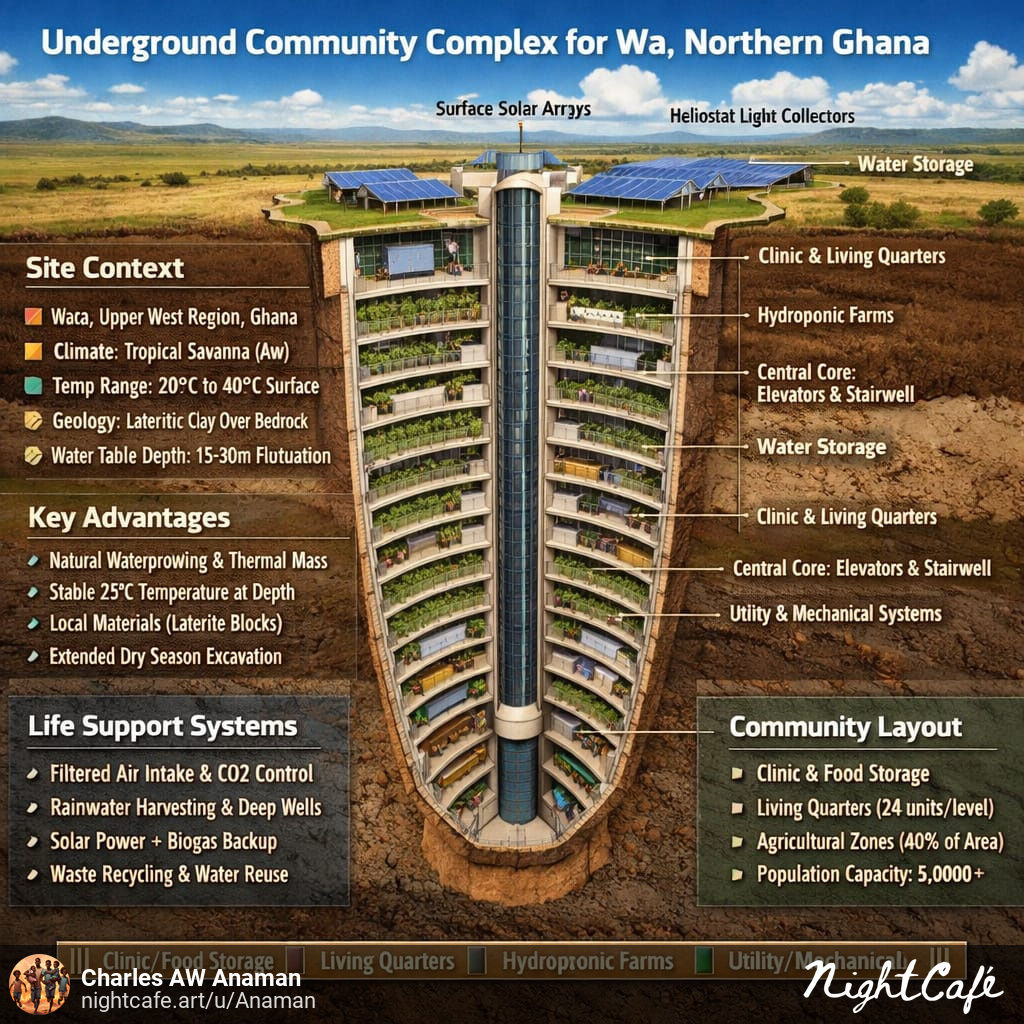
- Ad-hoc energy generation and storage to prevent disruption to either mining operations or basic power usage in a multilevel commercial unit
- Tool fabrication and repair capability – being able to manufacture equipment as it may be needed on-site for an apartment or factory is priceless
- Water and material processing systems – (On-site water filtration is critical to cleaning the water resources and also managing limited clean water availability or even grey water reuse)
- Air quality management and environmental stabilization (air quality control is critical in a mine as it is in a tall or deep residential complex)
Each of these systems acts as a buffer against disruption. {Concept design blow to help illustrate this idea}
Energy as the Foundation of Resilience
Energy systems are the first point of failure in most disrupted environments.
Traditional mining operations—and many housing systems—are heavily dependent on continuous external fuel or grid supply. When that supply is interrupted, operations halt.
A resilient approach requires:
1. Distributed Renewable Energy
- Solar photovoltaic systems for surface and near-surface operations
- Small-scale wind where viable
- Hybrid systems to smooth variability
2. Local Energy Storage
Energy storage is not optional—it is the stabilizing layer.
Practical approaches include:
- Lithium-based battery systems (widely available, high energy density)
- Emerging alternatives (e.g., sodium-ion or LFP variants where supply chains allow)
- Mechanical storage (flywheels, gravity systems) where appropriate
3. Underground Energy Integration
Mining environments present a unique opportunity:
- Thermal stability underground (typically more constant than surface temperatures) can improve battery performance and lifespan
- Physical protection from weather and surface-level disruptions
- Potential for integrated microgrid nodes within shafts and tunnels
This allows underground spaces to function not just as extraction zones—but as energy storage and distribution hubs.
Clean Energy Storage Underground — Practical Considerations
While underground energy storage offers advantages, it must be approached carefully.
Key design considerations include:
- Ventilation and thermal management (critical for battery safety)
- Moisture control and corrosion prevention
- Fire suppression systems appropriate for enclosed environments
- Modular deployment, allowing systems to be isolated or replaced without shutting down operations
These are engineering challenges—not barriers.
Extending Resilience into Housing and Community Design
The same principles apply to housing systems, especially in regions connected to extraction or industrial activity.
Resilient housing integrates:
- On-site renewable generation (solar rooftops, shared microgrids)
- Localized storage systems for outage continuity
- Passive thermal design to reduce energy demand
- Water capture and treatment systems
- Air filtration and environmental monitoring
The objective is not independence from the grid—but continuity during disruption.
Factories That Move: Building Capacity Where It’s Needed
One of the constraints in developing resilient systems is the lack of local manufacturing capability.
Our approach introduces a modular concept:
Mobile Fabrication Units (“Factories on Wheels”)
These are deployable systems designed to:
- Arrive at a site with core fabrication capability
- Produce essential tools, components, and infrastructure locally
- Train local operators and technicians
- Transfer operational knowledge
- Move to the next site once local capacity is established
These units can support:
- Metalworking and basic machining
- Assembly of renewable energy systems
- Fabrication of structural and mechanical components
- Repair and maintenance training
This model creates a distributed network of capability, rather than a centralized dependency.
Water, Air, and Material Systems as Core Infrastructure
Energy alone is not enough.
Resilient systems must also address environmental stability:
Water Systems
- Filtration and purification units
- Recycling and reuse systems
- Localized treatment to reduce dependency on external supply
Air Systems
- Dust and particulate filtration (critical in mining environments)
- Ventilation systems integrated with energy efficiency models
Material Processing
- On-site recycling of waste materials
- Reuse of tailings where safe and applicable
- Reduction of transport-dependent inputs
These systems reduce both operational cost and environmental impact.
Reducing Fragility Without Forcing Isolation
It is important to be clear:
This model does not reject global supply chains.
It re-balances dependence.
By ensuring that critical functions can continue locally, communities and operations gain:
- Greater stability
- Faster recovery times
- Increased economic participation
Resilience is not about doing everything alone—it is about not failing completely when systems around you do.
RW Rockshell Services: Building Transitional Infrastructure
RW Rockshell Services is focused on enabling this transition.
Our role is to:
- Design systems that can operate with partial independence
- Deploy modular infrastructure that can scale with local capability
- Integrate renewable energy with practical engineering systems
- Support knowledge transfer alongside physical deployment
The goal is not just to build systems—but to leave behind capability.
Closing
Resilience is not a feature you add later.
It is something you design from the beginning:
- In how energy is generated and stored
- In how tools are built and maintained
- In how knowledge is shared and preserved
If systems are designed to depend entirely on distant inputs, they will fail when those inputs stop.
If they are designed to adapt locally, they will continue.
That is the difference.